Showing posts with label LGBT rights. Show all posts

Friday, July 20, 2012

Battling on Behalf of Gay, Lesbians and Other Sexual Minorities: A Frontline Experience from Uganda

by Anonymous (an IRMA member from Uganda)

Are you aware you are abetting “homosexuality” in Uganda?


Our grass-root takes us among “most at risk populations”-MARPs. The day dawned normally as a carry-over from the previous weekend spent visiting 7 scheduled gay men living with HIV.


Come 8th March 2012 and another anonymous phone call. This time a lady claiming she sells insurance policy calling to meet over a policy I need to have! This was the 17th anonymous phone call I had received since 1st March 2012. Others were of people calling from different parts of Uganda. One ominous one intimated on why am helping people who don’t deserve aiding. This one was at night. I dismissed it as a hoax.

But, on 8th March 2012 I get the call that changed the way I do my grass-root work. I was asked to report to CID (Criminal Investigation Directorate) headquarters for matters concerning our organisation.


I left Uganda and went to a next door country where I stayed up to end of April 2012. How I survived while there is another story too.

My argument is that we need to show the good in all. And this is the mission we pursue. I don’t deny being vocal and instrumental in bringing about visibility of issues of: MSM, Sexual minorities, Long Distance Truckers, substance users, Fisher folk, discordant couples, persons in long term relations and mobile populations. I have helped document this kind of work and it has been the basis of my presentations during consultative meetings on MARPs. This kind of work was first done privately and goes back to 2004. I took up positions with the Ministry of Health-Uganda and have been involved in planning programmes targeting MARPs. After applying and waiting for 4 years our NGO was finally registered in 2011 and have since mobilized grass-root groups to focus on vigilance/ resilience plans.

There has been so much talk on prevention but less on what works among/for MARPs. The Rights agenda has done so much to lay bear action points. With these groups it has been possible to show that MARPs face disproportionate treatment and access. We have improved on their competence and overall sensitivity to issues. They are trained to address issues and overcome them using small steps and participatory planning. It has been possible to disaggregate efforts according to various categories MARPs (MSM, other sexual minorities Sex-workers, Substance users, Fisher-folk, Truckers, PLHIV and couples).

 This is what I have written about consistently for past 3 years. And all this is shared on: www.marpsinuganda.org.

MEETING CID PEOPLE:


I wish to share with you my story as I gave it during the 2 sessions I had with the CID guys. I hope this case which is given as a narrative and retrospectively will help show what activists experience in Uganda. It is about my work and how much I endeavoured to posit the angle of health programming. It is not easy to provide services to those who need especially if they are labeled as undesirables. But, this is a calling that if unanswered may lead to further injustices. I fear for being outed as a “chief recruiter” as I go about my work of treating and doing anti-HIV programmes among at risk populations. There is this battle of egos. I see myself as a public health activist and yet my interrogators and officials from government see me as a “recruiter” climaxing into closure of meetings, denial of safe spaces, fear of de-licensing NGOs, arbitrary detentions and summons to police.

The experience of being hounded by security operatives is un-nerving, un-settling and demotivating. I was asked to go to the CID to report myself because am known to work with MARPs. I at first was scared and had to call two friends for advice: one is part of the high powered state security team and another is our organisation lawyer. These two told me to go and meet the CID but before doing that I first called the person who called me (a one Byakagaba). I told Byakagaba about the security person. This softened my landing immensely. I called him to ask to be given an orientation on what we had to meet about. We negotiated a safer neutral place and he obliged. We later met a bigger team of interrogators at 3 pm up to around 9.30 pm. I think I saw a face of one person we met in two meetings at Protea and during the Uganda Human Rights Commission public hearing on the Anti-Gay Bill.

I remember this person could be the face I recall of one who followed me to the Protea washrooms and asked me why I take time to “help” the homosexuals. I was asked so many questions and many of them repeatedly. I want to share them.

Below are some of the questions that were asked. I want to present to you the questions I recall being asked of me and perhaps that will also give you a perspective of things:

Are you aware you are abetting “homosexuality” in Uganda?


1. Why do you recruit?

2. Who do you recruit? ( In the car to check offices/ resource center)

3. Why do you help?

4. Is everything on these 2 desk tops?

5. Who provides money for all the equipments in your office?

6. Why is your office/resource center in a walled off perimeter?

7. Why did you pay rent, electricity, water bills for a full year? (After going through all filed reports in our filing cabinets)

8. Who else is helping you?

9. How come you have a website?

10. Why is there even any work done among the “homosexuals”?

11. How large are those networks?

12. Why do you help them organize?

13. How much commission do you get from facilitating them (actually said helping)?

14. Why do you treat them?

15. What age group is commonly seen?

16. Where do most meet for recreation?

17. Your neighbours complain of loud noise. Why?

18. Who pays for all the activities?

19. Who come to your resource center?

20. Are there some who spend nights?

21. How many weddings have you conducted here?

22. Why are your phone numbers always busy?

23. Who pays for your airtime?

24. Why do you make it a point to bring out issues of “homosexuals”?

25. Who are MARPs?

26. Why do you sacrifice so much for “them”? ( Towards end of first session at around 8.30 pm)

27. How many have you helped? ( This was another burly faced individual who was looking at me with a very mean and intimidating look).

28. Do you use your position to recruit?

I noticed the desire to label, I noticed the conclusions made around serving the marginalised and noticed the lackadaisical tendencies of the security personnel that already deny one due diligence and attendance even as one who is thought/perceived to be a ‘homosexual’.

In order to get out of this quandary, I asked to be let off with what I was told as we were in the car being driven back for interrogations from our organization offices. Our organisation has consistently been run using our own money. We have come so far and we do not want to stop this work. I did negotiate my temporary freedom and the next day had to leave Uganda. I still wonder at the fate of what they took from our offices. I believe they are now using our two new desk tops for their cafes or have sold them off. I did manage to talk to my captors. I was told to move somewhere for quite some time until issues cool off.

They had suggested 6 months and beyond as opposed to being exiled to a far away off place away from Kampala and my work. I left Uganda with only have a shirt, pair of trousers, a data USB with all sensitive information and my travel bag.

In all this I learnt one big lesson and that is: we need to have the argument of HIV broken down as resilience activities.

These are what we need to document further and share with panels be they the CID! We need to document vigilance and how we, in our efforts actually mobilise, trace, follow up people and that way we are able to identify those with HIV! HIV at grass-root means: being in position to conduct anti-HIV activities; identifying those suffering; remedying the suffering by talking to them to know their needs; integrating psyche-social, sexual health, mental health; preventing abuses, violations, discrimination and stigma and; economic empowerment of those in need.

The individuals, clubs, groups and organisations are an asset and not a liability. I risked lecturing my interrogators but I cannot know where that courage came from and talking reason humbles even the gun-strapping-hand-cuff swinging arms! The use of the word “recruitment” is so common among criminal systems it is also used to relate to the Al-Shabbab issues. People are imagining penetrating “cells” of recruitment with all connotations attached. There should be a clear action point on bringing out health, human rights and development matters of marginalized based on evidence. This is possible.

Let us discourage actions or events that are lacking in integration of health, human rights and development.


I FLEE UGANDA:


I approached a human rights defenders’ support organisation and was extended USD 1,000 and a return air ticket to a country of temporary refuge. I had a government salaried job which I had to to leave, home and organization built out of sweat. While in refuge I tried the refuge and asylum seeking procedures. I went to organisations which in turn referred me to other organisations. We had to wait for outcomes. I understand there were so much back and forth consultations and in the long run no support was provided for my further stay during refuge.

I LOOK FOR WORK TO SURVIVE:


After two weeks I run out of money. I decided to do some work pro-bono around treating “marginalized” or training them in health/vigilance/resilience planning integration skills. A friend introduced me to another friend who runs a chronic care center and there I did some volunteer work. I would stay in a nurses’ station and use the washrooms. This place is near the capital city of the country I had taken refuge in. I enrolled for volunteer work during weekends and was fortunate that there were health camps scheduled in the various peoples’ spaces. I was given short contracts in health counselling at the various stations and other activities. I would in turn get a meal and continued social interactions. However, on 27th April 2012, I developed severe malaria which I treated and with some little money I had saved decided to leave for Uganda. I stayed around a border town up to 25th May 2012. I later left under the cover of darkness for our organisation address. I met with friends who lived nearby and managed to get first had intelligence about the affairs of our organisation and the fate awaiting us.

LANDLORD EVICTS US:


Our offices were in a double house turned office and our landlord had got wind of the CID house search in May 2012. He immediately asked us to leave his premises because we were promoting homosexuality according to word going around. In order to get safe passage, I went to police and got two escorts to guard us as we were moving property. We had to get another place where it was safer.

COMMENTS FROM THE NEIGBOURHOOD:


We located our offices in a suburb where most Kampala population has their homes. The various families and residents ganged together and complained to local leaders to have us evicted. There was so much pressure towards our landlord to have us out of the place. We even had graffiti written all over our perimeter wall. We left the premises at night and managed to avoid media.


WHAT WE ARE DOING NOW:


This is July 2012 and we have a smaller place, have managed to attach 170 people living with HIV to Uganda government ARV-accredited facilities. We have approached 112 CBOs and referred all our clients to them for chronic care support. We have managed to conduct a major training for the leaders of 52 groups under our society to take on more organisational roles to avoid so much exposure as people drop into our resource center. We have closed down the transitory home where we would give refuge to evicted marginalised persons. We have had this since 2008. We have joined the bigger networks and have paid membership dues. Such bigger networks include: Uganda National AIDS network; Uganda Health Sciences Association; Uganda National Academy of Science and; Microbicide Trial Network under the Makerere-Johns Hopkins Collaboration. The idea is to engage more with policy. Programmes have been left with the groups which we shall monitor progressively. Another crucial issue is to mobilise resources to enable our organisation move on. We have established a resource mobilisation desk which I head.

APPEAL:


Friends, allies and well-wishers should realize that Africa has a vast number of activists, many of whom have not been exposed through meetings at local or international levels. There are activists bound by professional ethics not to disclose so much information about their work especially if it concerns health conditions. There are activists using music, dance and drama to convey messages of tolerance and interventions. Many have not been thanked nor are they supported by funds from external sources. These activists deserve our appreciation.

It is my hope that the Global North will one day reach out to these un-sung activists who are using all resources to make the life of many marginalised bearable.

-------------------

*Join IRMA's robust, highly-active. moderated, global listserv addressing rectal microbicide research and advocacy as well as other interesting new HIV prevention technologies by contacting us at rectalmicro@gmail.com. Joining our listserv automatically makes you a member of IRMA - a network of more than 1,100 advocates, scientists, policy makers and funders from all over the world.

*Please look for us on Facebook: www.facebook.com/InternationalRectalMicrobicideAdvocates, and you can follow us on Twitter: @rectalmicro.

*Also, please note that shared news items from other sources posted on this blog do not necessarily mean IRMA has taken any position on the article's content.

-------------------

Thursday, June 21, 2012

Joyce Banda Intends to Decriminalize Homosexuality in Malawi

via pisnews.net, by Monica Tabengwa

Jun 14 2012 (IPS) - At a news conference shortly after she was sworn in as Malawi’s president, Joyce Banda announced her government’s intention to decriminalise homosexuality. It is unclear how she will achieve this, but the move is in stark contrast to the approach of her predecessor, Bingu wa Mutharika, who openly condemned it.

In a region in which lesbian, gay, bisexual and transgender (LGBT) rights have often been rejected in the name of traditional values, Banda’s stance is bound to attract attention. Hopefully, it will bring about some rethinking of policies that discriminate against LGBT people and often even criminalise homosexual practices.

In fact, Banda has taken a series of brave stands since she took office. Her refusal last week to host the African Union summit in July because the AU insists on having President Omar al-Bashir of Sudan there, despite his outstanding arrest warrant from the International Criminal Court, is just one of them.

And amending LGBT rights is another indication of her determination to lead Malawi back onto the path of being a forward-looking democracy and a state that respects universal human rights and global bodies such as the ICC over and above parochial interests.

Banda, the former vice president, inherited a grim economic situation when she took office in April, the first woman to become a head of state in the southern African region. Soon after taking office, she announced that she intended to repeal repressive laws and policies, some of them passed under Mutharika’s rule, including the laws criminalising same-sex acts.

The repeal of these repressive laws would be good news for Malawi and for Africa. It would not only spare members of the LGBT community the fear of prosecution, but would also negate the legitimisation of violence, abuse, and discrimination based on sexual orientation.

It would also be the first time since 1994 that an African country has repealed anti-LGBT legislation, and would add renewed impetus to global efforts toward decriminalisation of same-sex conduct.

Read the rest.


-------------------
*Join IRMA's robust, highly-active. moderated, global listserv addressing rectal microbicide research and advocacy as well as other interesting new HIV prevention technologies by contacting us at rectalmicro@gmail.com. Joining our listserv automatically makes you a member of IRMA - a network of more than 1,100 advocates, scientists, policy makers and funders from all over the world.

*Please look for us on Facebook: www.facebook.com/InternationalRectalMicrobicideAdvocates, and you can follow us on Twitter: @rectalmicro.

*Also, please note that shared news items from other sources posted on this blog do not necessarily mean IRMA has taken any position on the article's content.
-------------------

Friday, April 27, 2012

U.S HIV Funding for Gay and Bisexual Men May Cause Concerns

via Funders Concerned About AIDS, by Sean Cahill


Gay-Men-Holding-Hands.jpg
Over the past few years we have witnessed a number of advances in science-based HIV prevention and care policy and LGBT health policy in the U.S.

We have a first-ever National HIV/AIDS Strategy that prioritizes reducing the disparity affecting gay and bisexual men—who were 64% of new infections in 2009, although just 2% of the adult population.

We repealed a number of counterproductive policies dating back to the dark days of the 1980s and Senator Jesse Helms, such as ending the HIV entry ban, ending the ban on using federal funds for syringe exchange, and ending funding for abstinence-only-until-marriage education. Unfortunately, the latter two changes were short-lived. And we’ve seen long overdue increases in funding for Ryan White care, the AIDS Drug Assistance Program, HIV prevention through the CDC, and research at NIH, including promising biomedical prevention research.

In LGBT health policy—an overlapping area of concern as about 600,000 people living with HIV in the U.S. are gay and bisexual men and transgender women—we’ve got a public health strategy, Healthy People 2020, that prioritizes for the first time ending LGBT health disparities. President Obama has guaranteed hospital visitation rights for same-sex partners, offered domestic partner health insurance to civilian federal employees, and Secretary Sebelius is adding a sexual orientation question to the National Health Interview Survey. This is all great news, and we are grateful to our allies in government who have worked with community leaders to accomplish these important advances.

However, as the HIV epidemic among gay and bisexual men, and especially Black gay men, rages—with 30,000 gay men newly infected each year, 60% of them Black and Latino—federal government funding targeted toward gay and bisexual men and transgender women is not matching the demographics of the epidemic. Furthermore, critically needed, bold policy initiatives that address key structural drivers of vulnerability among gay men are lacking.


Read the Rest.


[If an item is not written by an IRMA member, it should not be construed that IRMA has taken a position on the article's content, whether in support or in opposition.]

Friday, April 6, 2012

World Delegates Fight to Protect Homosexuals and Prostitutes in Uganda

via AllAfrica.com, by Gloria Nakiyimba

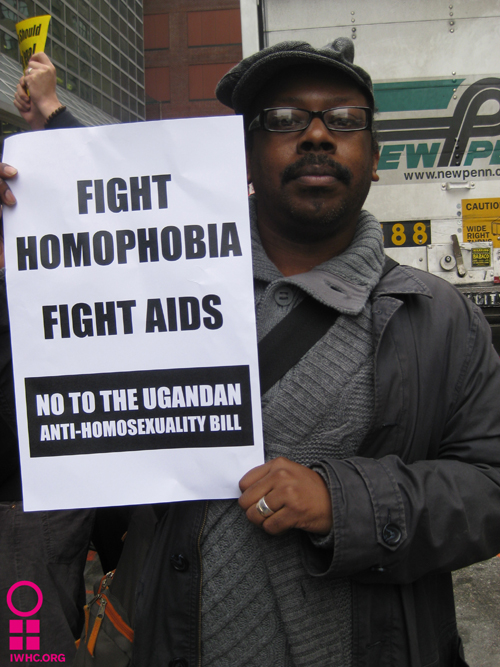
Damon Bolden at November 19th Rally Against Uganda’s Anti-Homosexuality BillWorld politicians meeting in the Ugandan capital, Kampala, have agreed on the need to repeal laws discriminating against HIV/Aids which they say have contributed to an increase in the rate of new infections.

MP's at the Inter Parliamentary Union assembly said laws that criminalize transmission of HIV, laws against sexual workers and those discriminating against sexual minorities need to be repealed.
Speaking during a panel discussion, Professor Sheila Tlou, UNAIDS Regional Director for Eastern and Southern Africa, said "there is a fear that a still highly stigmatized condition such as Aids can, and will, fall out of the agenda of national and global leaders".

Tlou said early signs of a decreasing commitment to Aids in the form of reduced funding for HIV prevention, treatment, care and support were worrying especially since the epidemic is far from being over.

She said where the law deepens social fractures and inequality, denies access to services and criminalizes those who need these services it becomes an obstacle to the Aids response.

In Uganda, the HIV and Aids Prevention and Control Bill 2010 was aimed at criminalising attempted transmission of HIV. The anti-homosexuality bill which remains on the shelves of parliament was identified as discriminatory and hampering the fight against HIV/Aids.

MP's called for zero discrimination against people living with Aids if the new campaign for zero new HIV infections and zero Aids related deaths is to be successful.

Tlou said UNAIDS was working with countries to introduce a programme to eliminate mother-to-child transmission to ensure that no child is born with the disease.

In 2009, the World Health Organization estimated there are 33.4 million people worldwide living with HIV/Aids, with 2.7 million new HIV infections per year and two million annual deaths due to Aids.

Ugandan MP Doctor Elioda Tumwesigy said 7,000 people are infected every day worldwide - half the number are women and girls in sub-Saharan Africa.

Read the Rest.


[If an item is not written by an IRMA member, it should not be construed that IRMA has taken a position on the article's content, whether in support or in opposition.]

Tuesday, April 3, 2012

Ugandan Gay Rights Activists Fight Against Anti-Homosexuality Bill

via Chicago Sun Times, by Frank Mugisha


The world listened last week as Liberian President Ellen Johnson Sirleaf defended her country’s laws that discriminate against its lesbian, gay, bisexual, transgender and intersex population. In an interview with the Guardian newspaper, she spoke of preserving Liberia’s “traditional values” and said in part, “We like ourselves the way we are.”

It’s a sad sentiment I hear in my own country of Uganda: the idea that homosexuality is somehow un-African and foreign to our culture, an import of the West that must be stopped. But it is not African to restrict another’s freedom. It is not African to spread lies and dissent and urge brutality against others. And it is certainly not African to deny fellow citizens basic human rights. No, these are ideas introduced and fostered by our colonizers, not by our ancestors.

My organization, Sexual Minorities Uganda, works against these forces of hate and division, and we live every day under the threats of violence that keep so many LGBTI Ugandans from coming forward. In 2010, a local newspaper published photographs and addresses of many of us under the headline “Hang Them.”

But still we work, because there is so much work to be done: gay men to be rescued from jail after arbitrary arrests and beatings. Lesbian women who need to be sheltered after curative rape assaults. Friends to be healed after being denied medical care.

The anti–gay groups call this struggle a campaign for gay rights. But there is nothing gay or straight about the right to worship, to assemble publicly or to live without fear of sanctioned brutality.

In Uganda today, bosses routinely fire employees suspected of being gay. We can be expelled from school or denied medical attention. Our friends and neighbors can be persecuted just for being seen with us.
The Ugandan Parliament is pushing a bill that is inspired by hateful ideas brought to us, not from within Africa, but by anti-gay activists like Scott Lively from the United States. The new law would equate gay people with pedophiles and call on the LGBTI population to stop “promoting homosexuality.”


The original version of the legislation even called for applying the death penalty to gay couples, and although it may be revoked from the final bill, even the more “palatable” version seeks to silence our voices, criminalize anyone who speaks on our behalf and encourage the wrongheaded stigmas that increase our nation’s rising HIV prevalence.
Read the Rest.


[If an item is not written by an IRMA member, it should not be construed that IRMA has taken a position on the article's content, whether in support or in opposition.]

Thursday, March 15, 2012

Ugandan Gay Rights Activists Take Action

via New York Times, by Laurie Goodstein

A Ugandan gay rights group filed suit against an American evangelist, Scott Lively, in federal court in Massachusetts on Wednesday, accusing him of violating international law by inciting the persecution of gay men and lesbians in Uganda.

The lawsuit maintains that beginning in 2002, Mr. Lively conspired with religious and political leaders in Uganda to whip up anti-gay hysteria with warnings that gay people would sodomize African children and corrupt their culture.

The Ugandan legislature considered a bill in 2009, proposed by one of Mr. Lively’s Ugandan contacts, that would have imposed the death sentence for the “offense of homosexuality.” That bill languished after an outcry from the United States and European nations that are among major aid donors to Uganda, but was reintroduced last month.

Mr. Lively is being sued by the organization Sexual Minorities Uganda under the alien tort statute, which allows foreigners to sue in American courts in situations asserting the violation of international law. The suit says that Mr. Lively’s actions resulted in the persecution, arrest, torture and murder of gay men and lesbians in Uganda.

Reached by telephone in Springfield, Mass., where he runs Holy Grounds Coffee House, a storefront mission and shop, Mr. Lively said he did not know about the lawsuit. Nevertheless, he said: “That’s about as ridiculous as it gets. I’ve never done anything in Uganda except preach the Gospel and speak my opinion about the homosexual issue.”

Mr. Lively is the founder and president of Abiding Truth Ministries. He is also the author of “The Pink Swastika: Homosexuality in the Nazi Party,” which says that Nazism was a movement inspired by homosexuals, and “Seven Steps to Recruit-Proof Your Child,” a guide to prevent what he calls “pro-homosexual indoctrination.”

He has traveled to Uganda, Latvia and Moldova to warn Christian clergy members to defend their countries against what he says is an onslaught by gay rights advocates based in the West.

Read the Rest.


[If an item is not written by an IRMA member, it should not be construed that IRMA has taken a position on the article's content, whether in support or in opposition.]

Thursday, February 16, 2012

Activists Hopeful on Repealing Anti-Homosexuality Law in Jamaica

viaThe Guardian by Sarah Boseley

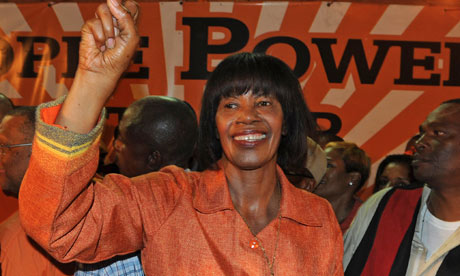
Portia Simpson MillerThey are one of the world's most beleaguered gay communities, brutalised by violence, hounded by a law that makes homosexual acts a crime and driven into the shadows in a country where four in five people admit they are homophobic. But now gay people in Jamaica are cautiously optimistic that change may be in the air.

A new government has begun making noises about an end to discrimination and repealing an anti-gay law. Portia Simpson Miller, standing for election as prime minister in December, declared that "no one should be discriminated against because of their sexual orientation", and indicated she would be willing to have gay people in her cabinet. "I certainly do not pry or do not have any intention to pry into the private business of anyone," she said. She won by a landslide.

Maurice Tomlinson, a Jamaican law lecturer and legal adviser to the advocacy group Aids-Free World, says he is delighted by the change of mood – although it has yet to lift the sense of insecurity felt by Jamaica's gay community. Tomlinson, a prominent voice for gay rights on the island, has fled his home because of death threats that followed his marriage to his male partner in Canada after a picture was published in the Toronto Star.

"I was advised to go into hiding," said Tomlinson, in London to collect an award named after murdered Ugandan gay rights activist David Kato for his advocacy work. "I went into a safe house for about three days because my passport was with the UK high commission waiting for a visa to come here.

"Right now I'm not sure if I will be able to go back to teaching this semester."

Tomlinson says Jamaican police have told him that attitudes on the island are unfortunate but "will not change until the law changes".

Even so, he does not yet want the conscience vote on the sodomy law that the prime minister suggested during the election. "Over 80% of Jamaicans have identified as homophobic," he says. "We want more time to explain to the Jamaican people how harmful the law is."

He wants them to know that the law contributes to the spread of HIV, which has a 32% infection rate among gay men compared with 1.6% in Jamaica's general population. Fear of being attacked and murdered drives lesbian, gay, bisexual, transgender and intersex (LGBTI) people to hide their sexuality. The prevalence of HIV puts them at risk but they do not get help to stay safe. Some gay men marry in a bid to seem straight to the outside world and that puts their wives and children at risk of HIV, says Tomlinson.

Read the Rest.


[If an item is not written by an IRMA member, it should not be construed that IRMA has taken a position on the article's content, whether in support or in opposition.]

Thursday, December 15, 2011

LGBTQ Discrimination Undermining HIV Prevention in Guatemala

via IPS News, by Danilo Valladares

Lesbian, gay, bisexual, and transgender people "face discrimination in health centres due to homophobia and transphobia, and do not receive treatment tailored to our needs. That's why we still represent the largest number of cases of HIV," Valdez told IPS.

Among men who have sex with men in the country, 7.6 percent were HIV-positive in 2010, according to the study "Intensificación de las acciones de prevención y atención integral en VIH y sida en grupos vulnerables y áreas prioritarias de Guatemala" (The Intensification of Preventive Actions and Integral Attention to HIV/AIDS in Vulnerable Groups and Priority Areas of Guatemala), carried out by World Vision.

However, other organisations put the prevalence of HIV/AIDS among sexual minorities much higher.

A total of 22,647 cases of HIV/AIDS were officially reported in Guatemala between 1984 and 2010, according to the ministry of health and social assistance, although NGOs say that figure would grow considerably if it included the unregistered cases.

Meanwhile, the Pan-American Health Organisation (PAHO) estimates that more than 65,000 people in this Central American country of 14 million people are living with the disease, many of them without even knowing it.

Valdez said the country has taken "few steps" for preventing the spread of HIV among vulnerable groups.

But one of the advances made was the opening of five clinics catering to members of sexual minorities.

"This kind of service should be available in all hospitals, in order to eliminate homophobia, which is the biggest hurdle we face," he said.

Read the rest here.


[If an item is not written by an IRMA member, it should not be construed that IRMA has taken a position on the article's content, whether in support or in opposition.]

The Effects of Criminalizing Same Sex Practices in Senegal

via PLoS ONE, by Tonia Poteat, Daouda Diouf, Fatou Maria Drame, Marieme Ndaw, Cheikh Traore, Mandeep Dhaliwal, Chris Beyrer, Stefan Baral

Abstract
 
Men who have sex with men (MSM) are at high risk for HIV in Senegal, with a prevalence of 21.5%. In December 2008, nine male HIV prevention workers were imprisoned for “acts against nature” prohibited by Senegalese law. This qualitative study assessed the impact of these arrests on HIV prevention efforts. A purposive sample of MSM in six regions of Senegal was recruited by network referral. 26 in-depth interviews (IDIs) and 6 focus group discussions (FGDs) were conducted in July–August 2009. 14 key informants were also interviewed. All participants reported pervasive fear and hiding among MSM as a result of the December 2008 arrests and publicity. Service providers suspended HIV prevention work with MSM out of fear for their own safety. Those who continued to provide services noticed a sharp decline in MSM participation. An effective response to the HIV epidemic in Senegal should include active work to decrease enforcement of this law.

Read the full study here.


[If an item is not written by an IRMA member, it should not be construed that IRMA has taken a position on the article's content, whether in support or in opposition.]

Wednesday, December 7, 2011

Obama and Clinton Pledge to Protect Gay Rights Throughout the World

via The New York Times, by Stephen Lee Myers

The Obama administration announced on Tuesday that the United States would use all the tools of American diplomacy, including the potent enticement of foreign aid, to promote gay rights around the world.

In a memorandum issued by President Obama in Washington and in a speech by Secretary of State Hillary Rodham Clinton here, the administration vowed to actively combat efforts by other nations that criminalize homosexual conduct, abuse gay men, lesbians, bisexuals or transgendered people, or ignore abuse against them.

“Some have suggested that gay rights and human rights are separate and distinct,” Mrs. Clinton said at the United Nations Human Rights Council in Geneva, “but in fact they are one and the same.”

Neither Mr. Obama nor Mrs. Clinton specified how to give the initiative teeth. Caitlin Hayden, the National Security Council’s deputy spokeswoman, said the administration was “not cutting or tying” foreign aid to changes in other nation’s practices.

Still, raising the issue to such prominence on the administration’s foreign policy agenda is important, symbolically, much like President Jimmy Carter’s emphasis on human rights.

With campaigning already under way in the 2012 presidential contest, Mr. Obama’s announcement could bolster support among gay voters and donors, who have questioned the depth of his commitment. He chose the Rev. Rick Warren, a pastor who opposes same-sex marriage, to deliver the invocation at his inauguration. Mr. Obama himself has not come out officially in favor of same-sex marriage. But he successfully pushed for repeal of the “don’t ask, don’t tell” policy that prevented gays from serving openly in the military. And the Justice Department has said it will no longer defend in court the Defense of Marriage Act, which defines marriage as between a man and a woman.

The initiative also invites attacks from Republicans trying to appeal to a conservative base in the primary and caucus states.
One Republican candidate, Gov. Rick Perry of Texas, said: “President Obama has again mistaken America’s tolerance for different lifestyles with an endorsement of those lifestyles. I will not make that mistake.”
It could also irritate some American allies, including countries like Turkey, where there have been reports of harassment, and Saudi Arabia, where homosexuality is banned and sex between people of the same sex is punishable by death or flogging.

Read the rest.


[If an item is not written by an IRMA member, it should not be construed that IRMA has taken a position on the article's content, whether in support or in opposition.]

Monday, November 7, 2011

Kenyan ex-pat (and IRMA Steering Committee Member) aims to help gay countrymen

[We are so proud of IRMA Steering Committee Larry Misedah - shown on the left in the pic below. His compelling story is a must-read. Of note, Larry will be joining a group of IRMA members in Addis Ababa this December for Project ARM - Africa for Rectal Microbicides organizing and strategizing activities taking place in advance of the ICASA 2011 conference.]


via Bay Area Reporter, by Heather Cassell

Excerpt:

Until recently, Kenyan LGBT individuals were isolated, believing they were the only ones in their community; some expressed the desire to take their own lives, said Misedah. Older gay and lesbian individuals were forced to marry people of the opposite sex. Younger queer Kenyans felt comfort from their problems with alcohol, said Misedah, who also felt the cold hand of isolation until he came out.

Coming out liberated Misedah, he no longer suffered from the isolation and instead became a beacon for others.

"I felt sort of obliged in order to speak for those who did not have a voice," said Misedah. "I just felt that we needed to speak more and let the society know the challenges that LGBTI people were facing."

He worked first with Ishtar MSM, one of Kenya's first organizations to provide health services to men who have sex with men. He served as the spokesman for Sexual Minorities Uganda's first media campaign. Misedah, in collaboration with IGLHRC, drafted the first Declaration on Transgender Rights for Central and East Africa in 2007 and continued to work on capacity building in Africa with IGLHRC. He spoke at the African AIDS conference in 2009.

Misedah, among others, risked the threat of up to 14 years of imprisonment under Kenya's penal codes sections 162 and 165 for attempted or homosexual behavior under "carnal knowledge against the order of nature."

Misedah, who came from a well-to-do family, found himself banished from his family and cut off from his educational support at the university, where he eventually obtained his bachelor's degree in environmental planning and management, he said.

Usually, families look the other way in regards to their LGBT family members who have financial resources and contribute to their families. Poor queer Kenyans, however, often find themselves in "deep trouble," said Misedah.
Read the rest.


[If an item is not written by an IRMA member, it should not be construed that IRMA has taken a position on the article's content, whether in support or in opposition.]

Saturday, September 24, 2011

David Kato Vision and Voice Award

via visionandvoiceaward.com

David Kato - human rights activist, friend, and colleague - was murdered in his home in Kampala, Uganda on 26 January 2011.

In recognition of his life and courage, and the continued struggle of lesbian, gay, bisexual, transgender and intersex (LGBTI) individuals around the world, partners committed to eliminating violence, stigma and discrimination have established the David Kato Vision & Voice Award.
Inspired by his work, the award recognizes the leadership of individuals who strive to uphold the numerous dimensions of sexual rights for LGBTI people. Sexual rights are an evolving set of entitlements related to sexuality that contribute to the freedom, equality and dignity of all people, and are an important aspect of human rights. The realization of these rights is also an integral element to a meaningful HIV response among these marginalized groups.

Click here for more award and nomination information.


[If an item is not written by an IRMA member, it should not be construed that IRMA has taken a position on the article's content, whether in support or in opposition.]

Friday, August 5, 2011

Homophobia stymies HIV fight in Islamic countries


Stigma and homophobia against gay men is hampering efforts to manage a growing epidemic of HIV in Islamic countries, warn epidemiologists this week.

"The stigma is a barrier to HIV prevention services," says Laith Abu-Raddad of the Weill Cornell Medical College-Qatar in Doha. He heads up a team that is assembling, for the first time, data from the Islamic world on the growing prevalence of HIV in practising gay men.

They report that the arrival of HIV in the gay community has been relatively recent compared with other regions of the world, but warn that it is on the rise. In Pakistan, for example, the prevalence of HIV in transgender male sex workers rose from 0.8 per cent in 2005 to 6.4 per cent just three years later.

Historically, HIV epidemics have often begun in minority, high-risk groups such as men who have sex with men or intravenous drug users, then spread to the general population. A problem in much of the Islamic world is that men having sex with men is illegal. That, coupled with homophobia, hampers efforts to contain the virus by making gay men too scared to seek treatment, a pattern that has been seen in eastern European countries, India and sub-Saharan Africa.

Read the rest here.

[If an item is not written by an IRMA member, it should not be construed that IRMA has taken a position on the article's content, whether in support or in opposition.]

Thursday, August 4, 2011

Narrow Window To Avert HIV Epidemics Among MSM in Middle East and North Africa

Via AIDSMap, by Michael Carter.

HIV epidemics are emerging among men who have sex with men (MSM) in a number of Middle Eastern and North African countries, an international team of investigators report in the online journal PLoSMedicine.

Prevalence of HIV was as high as 28% among some populations of MSM in Pakistan, and in 2008 over 50% of new HIV infections in Lebanon were in men who reported anal sex with another man.

High levels of risk behaviour in many countries suggested that there was the potential for further spread of HIV.

Alarmed by their findings, the investigatorssuggest “there is an urgent need to expand HIV surveillance and access to testing, prevention, and treatment services in a rapidly narrowing window of opportunity to prevent the worst of HIV transmission among MSM in the Middle East and North Africa.”

Worldwide, MSM are one of the groups most affected by HIV. The epidemic in most industrialised countries is focused on MSM, and research conducted in sub-Saharan Africa has found evidence of large but generally hidden MSM epidemics. Moreover, epidemics in MSM are well established and growing in Latin America and South East Asia.

In contrast, little is known about the MSM HIV epidemic in Middle Eastern and North African countries. Sex between men is often highly stigmatised in this setting, and in five countries homosexuality is punishable by death.

Given this lack in knowledge, a team of investigators lead by Dr Ghina Mumtaz undertook a systematic literature review to gain a better understanding of the HIV prevalence in MSM, their risk behaviour and knowledge of HIV in 23 North African and Middle Eastern Countries.

The authors believe their study “provides an integrated analysis and synthesis of the evidence to address the gap in our knowledge of what could potentially materialise as the key risk group for HIV sexual transmission in this region in the next decade.”

A total of 26 studies were included in the investigators’ analysis. They defined MSM as men who had insertive or receptive anal sex. However, the researchers emphasised that there was a huge diversity in MSM self-identity, role and behaviour in the region.

Overall, the prevalence of MSM behaviour was consistently between 2-3%. However, in some populations such as truck drivers (9%-49%) or street children (15%-77%) it was considerably higher.

Read the rest here.

[If an item is not written by an IRMA member, it should not be construed that IRMA has taken a position on the article's content, whether in support or in opposition.]

Tuesday, August 2, 2011

Former Ex-Gay Ugandan Man Now Regrets Past Homophobic Comments


A man who in 2009 renounced homosexuality at a public forum in Kampala has now told Behind the Mask that he regrets his previous actions and would like to be forgiven by the LGBTI community.

Saying that he felt “there is a fire in the belly saying gay is really who you are,” Mr George Oundo, known amongst Uganda’s LGBTI community as “Ms Georgina,” said that although he had renounced homosexuality on national media, at an opportune time he would ask the Kuchu community (Ugandan slang for LGBTI) to take him back.

Speaking on Wednesday July 27, 2011 to Behind the Mask outside the magistrate’s court in Kampala where three Christian evangelist preachers have been charged with making homophobic smears against a rival preacher, the now former ex-gay Oundo said he once again believed, “being gay is natural and inborn.”

The accused preachers, their lawyers, Henry Ddungu and David Kaggwa, together with David Mukalazi and Deborah Kyomuhendo (agents of the accused) face charges of conspiring to injure Pastor Robert Kayanja’s reputation by claiming that Kayanja sodomised boys in his church. The two lawyers are charged with allegedly commissioning false affidavits.

In March 2009 Oundo spoke at a Christian seminar and said he previously supported homophobic preacher Martin Sempa and legislator Mr David Bahati in their claims that homosexuals recruit children in schools and deserve the death penalty.

Speaking on Wednesday however, the now former ex-gay man said that he regrets the comments.

Looking sad, Mr Oundo, who once helped to establish an LGBTI human rights advocacy group in Kampala, said that although the preachers had given him some money and built him a house in Muyenga-Bukasa, a posh suburb of Kampala, he still had gay feelings. “I have never even become born again. I just do not want to be born again.”

Read the rest here.

[If an item is not written by an IRMA member, it should not be construed that IRMA has taken a position on the article's content, whether in support or in opposition.]

Monday, August 1, 2011

U.S. to Take Another Look at Gay Blood Donation Ban


A policy that bars gay men from donating blood for life is “suboptimal,” advisers to the Health and Human Services Department said on Tuesday, and needs another look.

HHS asked a committee of experts on blood and tissue donations to reexamine the policy and see if there is a way to let at least some gays donate blood.

“If the data indicate that a change is possible while protecting the blood supply, we will consider a change to the policy,” HHS said in a statement.

The U.S. Food and Drug Administration, an HHS agency, has banned blood donation by any man who has had homosexual sex because of the risk of the AIDS virus. Soon after the AIDS pandemic began in the 1980s, people such as hemophiliacs who received frequent blood transfusions or blood products began to become infected with the deadly and incurable virus.

Men who have sex with other men, including gay and bisexual men, have an HIV infection rate 60 times higher than that of the general population, the FDA says. They have an infection rate 800 times higher than first-time blood donors and 8,000 times higher than the rate of repeat blood donors. Tests cannot pick up a new HIV infection in the blood with 100 percent accuracy; because blood is often pooled, many people may be at risk from a single infected donor.

But the Red Cross, always struggling with blood shortages, and other groups such as gay-rights organizations oppose the blanket policy. They say that there are other ways to screen out donors at high risk of HIV infection. Sen. John Kerry, D–Mass., has also been pushing for a change in policy.

“We’ve been working on this a long time in a serious way, and I’m glad Secretary [Kathleen] Sebelius responded with concrete steps to finally remove this policy from the books,” Kerry said in a statement. “HHS is doing their due diligence, and we plan to stay focused on the endgame – a safe blood supply and an end to this discriminatory ban.”

Read the rest here.

[If an item is not written by an IRMA member, it should not be construed that IRMA has taken a position on the article's content, whether in support or in opposition.]

Homophobia in Ghana


Understanding the Drivers of Homophobia in Ghana


Recent condemnation of homosexuality by religious and political leaders in Ghana has led to a climate of fear preventing men who have sex with men (MSM) from accessing vital health services, say local NGOs.

The minister of Ghana’s Western Region, Paul Evans Aidoo, publicly described homosexuality as “detestable and abominable” after media reports in late May that 8,000 homosexuals had registered with health NGOs in the country’s west (the information appears to come from records kept by the NGOs of people who accessed services for MSM). Aidoo has since called for increased security in the region and the arrest of all homosexuals. Other religious leaders and politicians have followed suit, condemning homosexual activity.

As a result, far fewer MSM are accessing safe sex education and support programmes run by the Centre for Popular Education and Human Rights (CEPEHRG) to prevent the spread of HIV, said MacDarling Cobbinah from the Coalition against Homophobia in Ghana and a member of CEPEHRG.

“It has brought about a lot of fear and stigma for the people. It is difficult to organize programmes,” Cobbinah said. “It is very difficult for people to walk freely on the street… The call for arrest has really pushed people down.”

He added that one of his colleagues was recently accused of being gay and beaten up by a group of men.

Cobbinah said numbers had dropped at a regular HIV peer education programme that once had more than 20 people attending; two weeks ago only half the people came, and last week no one came, he told IRIN on 27 July. “They said, ‘If we come, we might be arrested.'”

An estimated 25 percent of Ghanaian MSM were HIV-positive in 2006, according to the US Agency for International Development (USAID).

According to the UN World Health Organization, since the beginning of the epidemic in the early 1980s, MSM have been disproportionately affected by HIV. The organization said social discrimination of MSM led them to delay or avoid seeking HIV-related information, care and services.

Other organizations in Ghana are also facing obstacles to providing vital services. An NGO based in the Western Region’s capital Sekondi-Takoradi, which distributes condoms and safe sex information to MSM, told IRIN that since Aidoo increased security and called for arrests they have felt threatened.

Male-to-male sexual relations are a crime in Ghana. Considered a misdemeanor, it carries a maximum sentence of six months, according to Kissi Agyabeng, a law lecturer at the University of Ghana. However, despite Aidoo’s calls for a crackdown, arrests do not yet appear to be taking place.

A spokesperson for the Sekondi-Takoradi NGO, who did not want his name or the organization’s name published for security reasons, said the NGO was now coming under pressure from the government to stop their work on HIV prevention if they did not reveal the names of MSM who have registered to use their services.

Stopping this work would affect thousands of people. In 2008, 2,900 people accessed their services, and by this year numbers had quadrupled, the spokesperson said.

...

Read the rest of the article here. For a fascinating personal story from a gay Ghanaian, read Paula Stromberg's article A Good Day in Ghana here.

[If an item is not written by an IRMA member, it should not be construed that IRMA has taken a position on the article's content, whether in support or in opposition.]

Monday, July 18, 2011

Building the momentum to prevent HIV in MSM

Via The Lancet, by Thomas J Coates.

Larry Kramer, on accepting the Tony Award last month from the Theatre Guild-American Theatrical Society for The Normal Heart as Best Revival of a Play said: “To gay people everywhere, whom I love so dearly…we are a very special people, an exceptional people, and…our day will come.” My day came in 1982 when I secured an Assistant Professorship in the Department of Medicine at the University of California, San Francisco. I set about establishing a behavioural medicine clinic fully integrated into general medicine practices, researching chronic disease prevention, and teaching interns and residents about psychological issues. One guest speaker, a social worker, led a discussion with the residents about the special medical needs of gay men. He was dead a month later from what later became known as AIDS.

The “special and exceptional people” cited by Kramer had lived through the 1970s and fought for human rights in the USA. That was followed in 1981 with the scourge of AIDS that could have knocked the wind out of the gay community. Instead, the community rallied and used its skills and talents to advocate for resources to develop community-based systems of care and prevention, and to ensure that human rights were not trampled.

Unleashing that energy and skill to build a global movement to improve HIV prevention and care services for men who have sex with men (MSM) is long overdue. Momentum is building and Chris Beyrer and co-authors make an important contribution. The Global HIV Epidemics among Men Who Have Sex with Men documents the extent of the HIV epidemic and outlines what needs to happen to ensure that everything possible is being done to prevent and treat HIV infection in MSM worldwide.

This volume documents the need in terms of the numbers, but also addresses the scenarios in which HIV epidemics among MSM exist in low-income and middle-income countries. The first scenario they describe, characterising the HIV epidemic in most of Latin America, is one in which MSM are the predominant exposure mode for HIV infection in the population. In these countries MSM are ten to over 100 times more likely to have HIV than the general population. By contrast, eastern Europe and central Asia have the highest rates of HIV among injection drug users (IDUs), but MSM are still several times more likely to have HIV than the general population. A different scenario is found in sub-Saharan Africa where HIV is widespread among heterosexuals, but even in these contexts MSM can have two to 20 times higher prevalence of HIV than the general population estimates. South, southeast, and northeast Asia are characterised by epidemics that have equal contributions from MSM, IDUs, and heterosexuals, although MSM are still at least ten times more likely to have HIV than the general population.

The needs come not only from the numbers. Beyrer and his co-authors document well the lack of prevention technologies focused on male-to-male transmission. They note that much effort has been expended on encouraging voluntary HIV counselling, testing, and behavioural interventions to decrease rates of unprotected anal intercourse by encouraging less risky sexual behaviours. Although important, such strategies are probably insufficient to produce immediate or lasting change in HIV transmission. Male circumcision may be effective for reducing acquisition of HIV through anal intercourse but we will never know for sure because of the challenges of conducting a trial to prove efficacy. Antiretroviral-based prophylactic approaches provide the best opportunity for managing HIV among MSM. In the wake of the IPREX, CAPRISA 004, and HPTN 052 trials, it is now time to accelerate efforts to determine if similar benefits can be obtained with rectal use of these or similar compounds. In some countries, like Peru where the epidemic is concentrated in MSM, providing universal access to care with MSM-sensitive services could actually change the overall trajectory of disease spread.

Read the rest here.

[If an item is not written by an IRMA member, it should not be construed that IRMA has taken a position on the article's content, whether in support or in opposition.]

Sunday, July 10, 2011

UPDATE ON UGANDA GAY-DEATH BILL

Via Mamba Online.

A member of parliament in Uganda says that the draconian Anti-Homosexuality Bill is likely to be made law within two months.

MP Otto Odonga, a member of the Legal and Parliamentary Affairs Committee in the country’s new parliament, told US professor and blogger Warren Throckmorton via Skype that the bill's author, David Bahati, will re-introduce the legislation as soon as possible.

"It will be expedited this time around and passed within one, maybe two months time,” Odonga said.

He added that the current committee would be able to make use of the report supporting the bill issued by the previous committee during the last parliament.

In May, legislators failed to debate and vote on the Anti-Homosexuality Bill after that parliamentary session ran out of time and was dissolved.

Originally introduced in October 2009, the Anti-Homosexuality Bill allows for the death penalty in cases of “aggravated homosexuality” and includes various criminal penalties for anyone who fails to turn over gay people to the police or who "promotes" homosexuality.

An international petition opposing the bill was signed by over 1.6 million people. It has been condemned by numerous governments around the world, some threatening to suspend aid to Uganda if it is passed.

[If an item is not written by an IRMA member, it should not be construed that IRMA has taken a position on the article's content, whether in support or in opposition.]

Friday, July 8, 2011

Gay Pride Rally in St. Petersburg Banned, Participants Arrested: Blog Updates

Via UK Gay News.

Saturday, June 25, 2011

10:35: Nice weather over St. Petersburg today. The city is enjoying what is called white nights. During this time of the year, there is light until very late at night.

12:45: A witness reports a lot of police near the monument to Peter the Great in central St. Petersburg. Skinhead groups have not yet been seen. The action is due to start in 75 minutes from now.

13:20: Details of the action are known to GayRussia but for safety reasons, we cannot write about it... a few more minutes to wait.

13:43: Anti-Gay groups which have been allowed by the city hall to stage an anti-gay protest a week ago did not show up – yet.

13:45: A first group is celebrating Pride on a boat, waiving Rainbow flags in front of the Statue to Peter the Great which is located near the river Neva. The boat is passing and tourists are taking photos of the participants waving their flags from the boat.

14:00: A second group started to unveil banners and flags shooting slogans “No to homophobia” or “Equal Rights”. A poster carried by trans activist Anna Komarova showed “Trans Rights are Human Rights”, one carried by Nikolai Alekseev played with the rumour that St Petersburg governor is alcoholic: “Alcoholism is a disease, homosexuality is not”. An another one carried which cannot be translated said “сосуЛИ Я? Тебя волнует?”

14:02: Everyone with a banner has been arrested. A very short action but participants have been able to waive their slogans in front of a large group of photo correspondents, TV crews and journalists.

14:05: Police have arrested a homophobe and are taking him to a police van. As he is being put into the van, he is giving Nikolai Alekseev ‘the finger’ While entering the van, he is showing Nikolai Alekseev with the finger and said “If you put me with him, I will kill him”. He is finally put in the same bus but in a separate compartment.

14:14: From the police van, Nikolai Alekseev explains: “We had a Pride of two minutes before being arrested and a homophobe started to attack us.”

14:40: Anna Komarova reports that Alexey Kiselev was beaten by a police officer inside the police station.

14:47: Nikolai Alekseev reports that after he told the police he will tweet about the beating of Alexey Kiselev inside the police station, the police replied to him: “Please tweet hello from me to Dmitri Medvedev”

14:55 Alexander Sheremetev, one of the organizers of Slavic Pride was beaten by a homophobe at the protest. His attacker has also been arrested.

16:25: The police said the activists will be charged with organising an illegal action but perhaps also of resisting police order. This second charge could lead to a 15-day prison sentence.

17:55: Nikolai Alekseev reports that he is with others in one room while trans rights activist Anna Komarova is in a cell without access to mobile phone.

Alexander Sheremetiev
19:00: Alexander Sheremetiev, one of the organisers who was attacked by a homophobe during the action has been taken to hospital in an emergency under police escort.

20:20: Andy Thayer from Gay Liberation Network is asking American, and a ‘veteran’ of three Gay Prides in Moscow has just said that he is calling the Russian Embassy in Washington D.C. “Gay Pride demonstrators brutally attacked & arrested in St Petersburg, Russia – facing poss 15 days in jail. Flood Russian embassy with calls to protest: 202-338-3263,” Thayer has posted on Facebook. Thayer was among those arrested at Moscow Pride last month.

20:50: In Berlin, gay activists are wasting no time. In 10 minutes (20:00 Central European Time) a protest in front of the Russian Embassy in Berlin. Is scheduled to start. The protest is organised by Norbert Blech, Maik Diekmannshemke, and Charles Meacham who were all in Moscow last month for the Pride. Berlin staged their Gay Pride (Christopher Street Day).

23:30: Detainees managed to keep a mobile phone. They told us that they have been put in two different cells (5 in one and 9 in another). “It is suffocating in this cell and the police denied us water,” said the text message we received.


Sunday, June 26, 2011

01:00: “It is like a torture in this cell. We cannot sleep. It is so hot. We are all wet,” says a text message received from Nikolai Alekseev in his police cell.


The protest in Berlin. Protestors
carry images of those arrested.

9:58: Overnight, Peter Tatchell, human rights campaigner, reacted to yesterday’s suppression of Slavic Pride. “The arrest, mistreatment and detention of LGBT activists is illegal under Russia’s constitution, which guarantees the right to peaceful assembly. It is alarming that this homophobic repression is taking place in Russia’s most liberal city, St Petersburg. The Council of Europe must take disciplinary action against Russia over it’s further violation of the European Convention on Human Rights (ECHR). The Russian government must not be allowed to defy the ECHR with impunity.” Tatchell has regularly attended Pride attempts in Moscow since 2006 where he was arrested and severely beaten.

11:00: SMS message from Alexander Sheremetiev: “We are still in the cell, no info on Court hearing. It was supposed to start at 10am but it is 11am now.”

11.20: On Twitter, Nikolai Alekseev reports: “It was my third overnight stay in police detention. One after Moscow Pride in 2007, one after Slavic Pride in Moscow in 2009. It was an unbelievable night. I would say this should be considered as torture. Cell 4 by 2 meters with wooden benches for 10 people.

12.40: The Court hearing has not yet started the hearings.

12.51: Nikolai Alekseev reports from inside the Court via SMS: “Police entered the court room to talk with the judge. No one else is there. You can guess the justice we might have!”

13.18: Nikolai Alekseev reports from Court via Twitter: “Breaking! First court verdict. Anton Sutyagin fined 500 rub (12 euros) for illegal protest, hearing on disobedience postponed to 6 July.”

14.08: Nikolai Alekseev reports by phone: "Alexander Sheremetyev who was beaten by the homophobe at the protest is released. His hearings are transferred to 6 July so he is not fined yet. Varvara Krasutskaya is with me out of the Court, she was also fined 500 roubles. Anna Komarova was fined 1,000 roubles on the basis that he had been arrested before in St. Petersburg.”

14.39: Chief organiser of St. Petersburg Pride and head of Equality, Yuri Gavrikov, is released. Fined 1000 rub, hearing on other charge on 11 July.

14.39: Nikolai Alekseev reports via Twitter: “I adore all who took part in Slavic Pride. Fabulous Belorusians! Amazing locals. So devoted activists.”

Read the rest of the entries here.

[If an item is not written by an IRMA member, it should not be construed that IRMA has taken a position on the article's content, whether in support or in opposition.]
Related Posts Plugin for WordPress, Blogger...