Showing posts with label Jamaica. Show all posts

Thursday, February 16, 2012

Activists Hopeful on Repealing Anti-Homosexuality Law in Jamaica

viaThe Guardian by Sarah Boseley

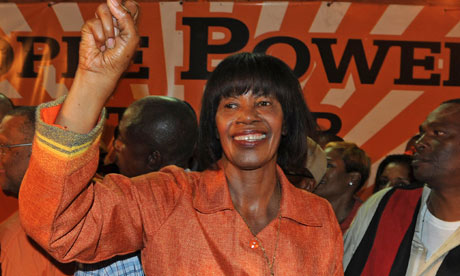
Portia Simpson MillerThey are one of the world's most beleaguered gay communities, brutalised by violence, hounded by a law that makes homosexual acts a crime and driven into the shadows in a country where four in five people admit they are homophobic. But now gay people in Jamaica are cautiously optimistic that change may be in the air.

A new government has begun making noises about an end to discrimination and repealing an anti-gay law. Portia Simpson Miller, standing for election as prime minister in December, declared that "no one should be discriminated against because of their sexual orientation", and indicated she would be willing to have gay people in her cabinet. "I certainly do not pry or do not have any intention to pry into the private business of anyone," she said. She won by a landslide.

Maurice Tomlinson, a Jamaican law lecturer and legal adviser to the advocacy group Aids-Free World, says he is delighted by the change of mood – although it has yet to lift the sense of insecurity felt by Jamaica's gay community. Tomlinson, a prominent voice for gay rights on the island, has fled his home because of death threats that followed his marriage to his male partner in Canada after a picture was published in the Toronto Star.

"I was advised to go into hiding," said Tomlinson, in London to collect an award named after murdered Ugandan gay rights activist David Kato for his advocacy work. "I went into a safe house for about three days because my passport was with the UK high commission waiting for a visa to come here.

"Right now I'm not sure if I will be able to go back to teaching this semester."

Tomlinson says Jamaican police have told him that attitudes on the island are unfortunate but "will not change until the law changes".

Even so, he does not yet want the conscience vote on the sodomy law that the prime minister suggested during the election. "Over 80% of Jamaicans have identified as homophobic," he says. "We want more time to explain to the Jamaican people how harmful the law is."

He wants them to know that the law contributes to the spread of HIV, which has a 32% infection rate among gay men compared with 1.6% in Jamaica's general population. Fear of being attacked and murdered drives lesbian, gay, bisexual, transgender and intersex (LGBTI) people to hide their sexuality. The prevalence of HIV puts them at risk but they do not get help to stay safe. Some gay men marry in a bid to seem straight to the outside world and that puts their wives and children at risk of HIV, says Tomlinson.

Read the Rest.


[If an item is not written by an IRMA member, it should not be construed that IRMA has taken a position on the article's content, whether in support or in opposition.]
Tuesday, May 10, 2011

The Caribbean: State-Sponsored Homophobia Helps Spread HIV

via Open Society, by David Scamell

A few weeks ago, civil society groups and human rights activists from across the Caribbean met with officials from UNAIDS, UNDP, and various national governments to talk about the impact that laws have on the HIV epidemic in the region. The meeting was the second regional dialogue of the UNDP Global Commission on HIV & Law, and was held in a region where a number of governments continue to use the law to persecute sexual and gender minorities.

According to the 2010 report from the International Lesbian and Gay Association, State-Sponsored Homophobia, 11 of the 13 Caribbean states criminalize sex between men. Under the continuous threat of imprisonment and police abuse, as well as discrimination from other citizens and even family members, gays and other men who have sex with men (MSM) in these countries are often driven away from the health and social services that they need. The same services, such as access to condoms and voluntary HIV testing and counseling, which are crucial in the fight against HIV.

Unsurprisingly, HIV among MSM is a relatively hidden but increasing problem for the Caribbean. In a region where the general adult HIV prevalence is second only to sub-Saharan Africa, at one percent of the population, infection among MSM is disproportionately high. For example, one in three MSM in Jamaica and one in five in Trinidad and Tobago are living with HIV.

Read the rest.

[If an item is not written by an IRMA member, it should not be construed that IRMA has taken a position on the article's content, whether in support or in opposition.]

Tuesday, April 19, 2011

Jamaicans making it difficult for gays to stay with one partner?

via Jamaica Observer

ONE of the world's leading bioethics publications, Developing World Bioethics Journal, says Jamaicans are making it difficult for men who have sex with men (MSM) to be monogamous. The publication also suggested that Health Minister Rudyard Spencer is unhappy with the fact that his government "continues to support legislation that contributes significantly to the high prevalence of HIV/AIDS among MSM". 

Following are excerpts from the recently published article:

"It is tempting to feel sorry for Jamaica's Health Minister, the Hon Rudyard Spencer. There he is, trying his best to do his job, and, among other urgent health matters, reduce the incidence of HIV/AIDS in his nation.

Unfortunately, on his own account, this is proving to be next to impossible unless Jamaicans change their cultural attitudes to — you guessed it — sex. The Jamaican Ministry of Health's website quotes him with these eminently sensible concerns about specific attitudes:

"These include a widely held belief that sex with a virgin can cure HIV/AIDS, the high level of sexual relations between older men and young girls and a persistently hostile anti-gay environment which all contribute to the stigmatisation and discrimination of infected and affected persons. A strong religious culture also inhibits open discussion on matters of sexuality... We too need to begin the process of unlearning those beliefs that endanger the health lives of others and rethinking the tendency to be obscene and degrading in rejecting values that conflict with our own..."

Read more.


[If an item is not written by an IRMA member, it should not be construed that IRMA has taken a position on the article's content, whether in support or in opposition.]

Thursday, November 4, 2010

Homophobia, Stigma and HIV in Jamaican Prisons

From Culture, Health and Sexuality, by Andrinopoulos, Figueroa, Derrigan and Ellen

From the Abstract:

Success in addressing HIV and AIDS among men who have sex with men, a key population in the global epidemic, is impeded by homophobia. Homophobia as a barrier to HIV prevention and AIDS treatment is a particularly acute problem in the prison setting. In this qualitative study, we explore HIV and AIDS, stigma and homosexuality in the largest all male prison in Jamaica by conducting iterative in-depth interviews with 25 inmates. Participant narratives unveil a purposeful manipulation of beliefs related to homosexuality that impedes an effective response to HIV and AIDS both in prison and wider society. Findings indicate that homophobia is both a social construction and a tangible tool used to leverage power and a sense of solidarity in a larger political and economic landscape. This use of homophobia may not be unique to Jamaica and is an important issue to address in other low- and middle-income post-colonialist societies.

Read the article

[If an item is not written by an IRMA member, it should not be construed that IRMA has taken a position on the article's content, whether in support or in opposition.]

Wednesday, April 14, 2010

Should we care about MSMs?


"The threats of criminal indictment and socio-religious discrimination against man-to-man sexual relationships have contributed to the increased vulnerability of MSMs to HIV," said Cruickshank.

 "Consequent to such discrimination, many MSMs are afraid of going to a pharmacy to purchase condoms and personal lubricant which are sometimes so precariously placed close to the cashier, in full view of other customers. Hence, negotiation of safe sex becomes seriously compromised."

Read the rest.

Wednesday, November 25, 2009

Homophobic Ugandan Bill Demonizes People with HIV

Remarks by Stephen Lewis, Co-Director of AIDS-Free World delivered at the Commonwealth People's Forum on the eve of the Commonwealth Heads of Government Meeting (CHOGM) Tuesday, November 24, 2009, 10:00 a.m., Port of Spain, Trinidad and Tobago:

It’s one thing to talk about the promotion of the ‘traditional family’ as the author of the Bill does ad nauseam; it’s quite another thing to incite the promotion of disease and murder. Gays and lesbians don’t challenge traditional families; their private sexual practices don’t invade the sanctity of family life. The accusation is a vile canard. People who plead the supremacy of family values over other human values have one of two motives: either they’re biblical fundamentalists whose religiosity has gone haywire, or they’re so steeped in irrational fear of different sexual orientation that human rights have no meaning. 


This is a moment of truth for the Commonwealth. The anti-homosexuality Private Member’s Bill introduced into the parliament of Uganda, and now proceeding through the normal legislative process, puts the Commonwealth’s legitimacy and integrity to the test.

In a fashion unmistakable in both clarity and intent, the putative legislation declares war on homosexuality. There are deeply offensive sodomy laws and homophobic statutes on the books of many other Commonwealth countries, particularly here in the Caribbean. But nothing is as stark, punitive and redolent of hate as the Bill in Uganda; nothing comes close to such an omnibus violation of the human rights of sexual minorities. For some time now, Uganda has had offensive anti-homosexual legislation on the books, but this variant, this inflammatory redesign makes of the law a veritable charter of malice.

What is truly staggering about all of this is that not a peep of skepticism or incredulity has come from President Museveni (pictured). And President Museveni is chairing the Commonwealth Heads of Government summit. In so doing, he makes a mockery of Commonwealth principles.

One must remember that the last meeting of CHOGM was held in Uganda in 2007, and issued what is called the “Munyonyo Statement of Respect and Understanding”. It asserted that the Commonwealth “is a body well-placed to affirm the fundamental truth that diversity is one of humanity’s greatest strengths”. It went on to say that “accepting diversity, respecting the dignity of all human beings, and understanding the richness of our multiple identities have always been fundamental to the Commonwealth’s principles and approach …”. President Museveni signed the document. How in the world does he reconcile the affirmation then with the defamation now?

It is noteworthy that much of the strongest opposition to the Bill is coming from the courageous Lesbian, Gay, Bisexual, and Transgender activists on the ground. LGBT activism always commands admiration, but in this instance especially so, because their very lives hang in the balance.\


Tuesday, September 22, 2009

Homophobia intensifies Jamaican HIV epidemic

How AIDS became a Caribbean Crisis
via Atlantic Online, by Micah Fink


“If it were AIDS that were killing us,” he said, “I would use a condom. But it’s people, not AIDS, that is killing us. AIDS has nothing to do with it.”

We may be accustomed to thinking of AIDS as most rampant in distant parts of the world like Africa, India, and South Asia. But these days the epidemic is flaring up a bit closer to home, in the Caribbean. Indeed, AIDS is now the leading cause of death among adults there, and the Caribbean’s rate of new infections is the second highest in the world, following just behind Sub-Saharan Africa.

A major factor in the region’s susceptibility to the epidemic is its pervasive atmosphere of homophobia, which makes education and outreach efforts nearly impossible. Jamaica, which lies near the middle of the Caribbean and, as of last year, was found to have an astounding 32 percent HIV infection rate among gay men, offers a case study in how anti-gay attitudes have helped spread and intensify the epidemic’s impact.

In Jamaica, homophobic attitudes are reflected in everything from laws that criminalize anal sex, to the lyrics of popular dancehall music that celebrates the murder of gay men, to widespread acts of anti-gay violence, and a gay culture of sexual secrecy and high-risk behavior. Each of these factors is intensified by a religious context that defines homosexuality as a mortal sin and points to the Bible for moral justification in violently rejecting the concerns of the gay community.

Read the rest.

Friday, August 7, 2009

Stephen Lewis on homophobia

[Excerpt from Stephen Lewis' speech at the IAS Conference, Cape Town, South Africa, July 19, 2009. Read the full speech.]

When the Government of Senegal jails eight gay AIDS activists for no reason except homophobia, setting back the fight against AIDS, where are the scientific voices of condemnation?

Right now, in the Caribbean, every country save the Bahamas, has laws that criminalize homosexuality. We tiptoe round this twisted form of racism. We submit to ridiculous claims of cultural relativism.


The Prime Minister of Jamaica, in the safety of Parliament, makes the most contemptible statements about gay men, leaving every elemental component of human rights in tatters, and he’s never called to account ... not by the UN Human Rights Council, not by the G8, not by the G20, not by the Commonwealth … only by the gay activists themselves.

What is wrong with the international community? If this is how it behaves, it doesn’t deserve the name “community” at all.

And if the political leadership lacks the courage to confront such outrageous slander, you shouldn’t lack the courage. You’re scientists. You know that it’s a scientific reality that a certain percentage of the world’s people is gay. So tell the political philistines to get over it and stop wrecking such damage. More, you know that an ugly homophobic culture is a threat to public health that inevitably serves to spread the virus … I beg you to say so. The majesty of science is its influence.

Tuesday, June 30, 2009

There are no gay pride parades in Jamaica


via Worldfocus

Lisa Biagiotti is working on signature stories for Worldfocus on HIV/AIDS and homophobia in Jamaica. She reported with Producer Micah Fink and Director of Photography Gabrielle Weiss, both from the Pulitzer Center on Crisis Reporting. Their reports will air on Worldfocus later this summer. Lisa gave the below interview to Thirteen.org.

Q: Gay pride is celebrated across the U.S. every June. Could there be similar celebrations of gay pride in Jamaica?

Lisa Biagiotti: No, there could not be an openly gay pride parade on the streets of Kingston, Jamaica, as in New York or San Francisco. In Jamaica, anti-sodomy laws criminalize sex between men, fundamentalist interpretations of the bible and pride in reproduction contribute to the general disdain and non-acceptance of the gay lifestyle.

Read the rest.


Thursday, March 12, 2009

Jamaica: Gay men in hiding - Avoiding health care because of stigma, survey suggests


via The Gleaner, by Petrina Francis

AS DEBATE stirs over the Jamaican Government's insistence on retaining legislation against buggery, homosexual men continue to suffer from discriminatory acts which make it difficult for them to seek health care in the country, a study has indicated.

A 2008 survey commissioned by the Ministry of Health showed 31.8 per cent of gay men in Jamaica are living with HIV. Another 8.5 per cent were found with chlamidia, 2.5 per cent had gonorrhoea and 5.5 per cent had syphilis.

According to a release from the Caribbean HIV & AIDS Alliance (CHAA), the high number of sexually transmitted infections among gay men, sometimes termed men who have sex with men (or MSM), is linked to the way they are treated by the law and members of the general population, including those in the health sector.

Read the rest.


Wednesday, December 10, 2008

J-FLAG celebrates tenth anniversary


Kingston – December 10, 2008

December 10, 2008 marks ten years since the founding of the Jamaica Forum for Lesbians, All-sexuals and Gays (J-FLAG), Jamaica’s foremost lesbian, gay and transgender rights advocacy group. The anniversary will be commemorated with a church service on the weekend. As J-FLAG celebrates this milestone, it pauses to reflect on the challenges and successes that have shaped its journey thus far.

Started by a group of 12 business people, educators, lawyers, public relations practitioners, advertisers and human rights activists, J-FLAG was launched in the wee hours of December 10, 1998. The organisation was born out of the need to advocate for the protection of lesbians, gays and transgenders from state-sanctioned and community violence. In this regard, J-FLAG’s call was for the fair and equal treatment of gays and lesbians under the law and by the ordinary citizen.

The organisation’s birth was condemned and decried by most as a foolhardy venture that would result in a backlash against members of the country’s lesbian, gay, bisexual and transgender community. On the other hand, it was welcomed by a few as a bold attempt to recognise lesbians, gays and transgenders as members of plural Jamaican society.

After ten years of existence, J-FLAG can boast of having survived in one of the most inhospitable environments for gays, lesbians and transgender people. Indeed, much of J-FLAG’s work has revolved around the rescuing of community members from violent situations or attempting to deal with the aftermath of such situations. In fact, the violent death of Brian Williamson, one of the co-founders of J-FLAG—and for years its voice and face—and the recent departure of Gareth Henry, a former programmes manager of the organisation, testify to the dangerous environment in which the organisation operates.

Yet J-FLAG has been able to do what was, ten years ago, unthinkable in Jamaica. It has visited and made presentations on sexuality and human rights to a variety of local and international organisations, including religious, civic and human rights groups as well as tertiary educational institutions and the police. It has also met with and given interviews with radio and newspaper reporters. But perhaps its most significant achievements have been the submission to parliament regarding the addition of sexual orientation as a category for which there should be constitutional protection against discrimination and the assistance, in 2006, to relaunch the Caribbean Forum for Lesbians, All-sexuals and Gays (C-FLAG).

Over the ten years of its existence, J-FLAG has stood as a singular voice in Jamaica calling for the respect of lesbians, gays and transgenders as citizens with the same rights and value as heterosexual Jamaicans. For the next phase of its journey, the organisation will continue calling Jamaicans to a deeper understanding of their plurality and their democracy; it will continue seeking to raise the level of debate in the society about the meaning of tolerance and the acceptance of difference. Accordingly, J-FLAG will attempt to forge new relationships with a wider cross-section of organisations committed to strengthening democracy and the promotion of respect for all Jamaicans, regardless of sexual orientation, gender, creed, religion or social status.
Related Posts Plugin for WordPress, Blogger...